
Engineered for extreme reliability, industrial durability, and maximum lumen efficacy in municipal, highway, and large-scale commercial deployments.
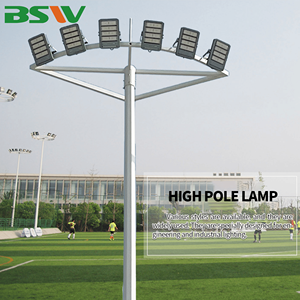
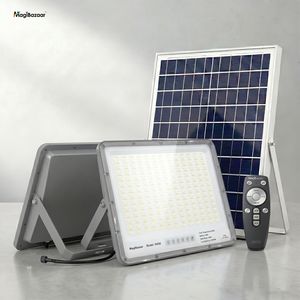
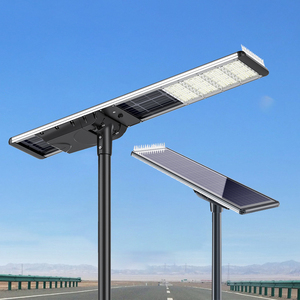
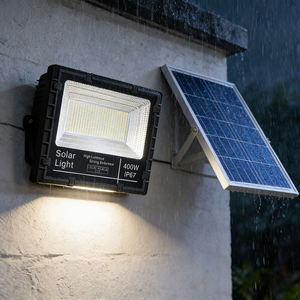
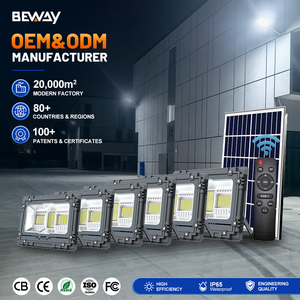
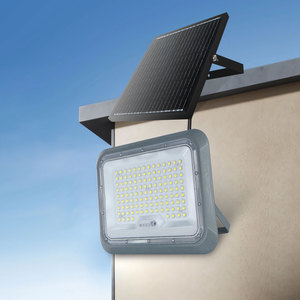
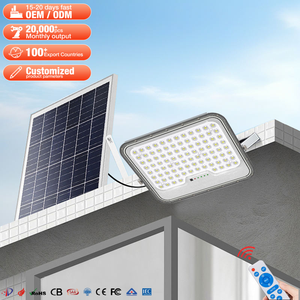
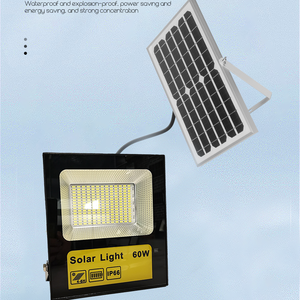
With over two decades of solar engineering leadership, SOLTECH operates 5 vertically integrated manufacturing plants delivering complete off-grid lighting ecosystems.
Unlike assemblers relying on third-party OEM components, SOLTECH manufactures die-cast aluminum enclosures, solar panels, smart MPPT charge controllers, and optical lenses internally across our 5 state-of-the-art factories. This ensures strict quality compliance to DLC Premium 5.1 and UL standards.
Equipped with automotive-grade Lithium Iron Phosphate (LiFePO4) cell chemistry, our batteries deliver 3,500+ deep-discharge cycles at 80% DOD. Integrated Smart BMS provides multi-stage protection against overcharging, deep discharge, short-circuit, and extreme ambient temperature ranges (-20°C to +65°C).
SOLTECH luminaires are engineered to meet Buy America Act (BAA) provisions for federally funded transportation projects. Certifications include DLC, UL Listed, CE Mark, and IDA Dark-Sky Approved optics to eliminate light pollution in suburban and wildlife-sensitive habitats.
The global transition toward decentralized clean energy infrastructure has reshaped municipal outdoor lighting specification criteria. Commercial utility solar street lights are no longer viewed merely as standalone off-grid novelties; they represent mission-critical urban assets capable of delivering grid-independent reliability, zero lifetime utility operational costs, and reduced municipal carbon liabilities. This whitepaper evaluates the optical, solar, and electrochemical engineering advancements driving the industry forward, offering procurement officers and electrical consulting engineers actionable insights for infrastructure specification.
The performance foundation of any commercial solar utility luminaire is its solar photovoltaic (PV) array. Historically, conventional solar street lights utilized P-type PERC (Passivated Emitter and Rear Cell) monocrystalline panels yielding solar conversion efficiencies between 18% and 20.5%. Modern utility-grade systems—such as SOLTECH's SATELIS PRO and HYPER PRO series—have transitioned to N-Type TOPCon (Tunnel Oxide Passivated Contact) and high-efficiency monocrystalline silicon technologies achieving cell conversion efficiencies exceeding 23.5%.
This leap in PV efficiency provides distinct operational advantages for municipal applications:
Battery longevity has historically been the primary failure point in off-grid solar illumination. Legacy installations using Gel, Sealed Lead-Acid (SLA), or nickel-manganese-cobalt (NMC) lithium chemistry suffered from severe thermal degradation and low cycle life. Modern commercial solar street lighting standards mandate Lithium Iron Phosphate (LiFePO4) chemistry due to its intrinsic thermal stability and chemical resilience.
| Energy Storage Parameter | Lithium Iron Phosphate (LiFePO4) | NMC Lithium Ion | Sealed Lead-Acid / Gel |
|---|---|---|---|
| Cycle Life (80% DOD) | 3,500 – 6,000 Cycles | 1,000 – 1,500 Cycles | 500 – 800 Cycles |
| Thermal Runaway Point | +270°C (Extremely Safe) | +210°C (Moderate Risk) | +60°C (Gassing Risk) |
| Operating Temp Range | -20°C to +65°C | -10°C to +50°C | -10°C to +40°C |
| Depth of Discharge (DOD) | 90% Max Utilization | 80% Max Utilization | 50% Max Utilization |
| Design Life Expectancy | 8 to 12 Years | 3 to 5 Years | 2 to 3 Years |
To withstand extreme winter freezing, SOLTECH integrates Smart Battery Thermal Management (BMS) systems equipped with integrated heating elements. When ambient temperatures drop below freezing, excess solar power is diverted to gently heat the LiFePO4 cells to safe charging thresholds, enabling uninterrupted operation in cold weather conditions down to -40°C.
Achieving required foot-candle illumination levels on roadway surfaces while minimizing dark-sky light spill requires advanced optical engineering. Modern commercial solar LED luminaires utilize high-transmittance optical grade Polycarbonate (PC) or PMMA lenses designed for specific Illuminating Engineering Society (IES) light distribution patterns:
By pairing high-efficacy Lumileds 5050/3030 LED chips with precision optical lenses and pure sine-wave MPPT driving electronics, SOLTECH luminaires achieve system efficacies exceeding 200 Lumens per Watt. This high optical efficiency allows a 30W solar luminaire to generate over 6,000 lumens—delivering light output equivalent to traditional 150W Metal Halide fixtures while reducing solar panel and battery size requirements by 50%.
Maximum Power Point Tracking (MPPT) charge controllers serve as the central processing unit of modern off-grid solar street lights. High-frequency digital MPPT algorithms track the solar module’s current-voltage (I-V) curve at millisecond intervals, extracting up to 98.5% of available solar energy even under partial shading or overcast skies.
Furthermore, smart controllers execute adaptive dimming profiles based on real-time battery State of Charge (SoC). Instead of shutting down during prolonged multi-day rain events, the system automatically recalibrates output current to preserve core security illumination—guaranteeing 7 to 10 consecutive nights of continuous operation without grid backfeed.
Key industry shifts that procurement officers, civil engineers, and solar distributors must navigate for 2025–2030 infrastructure projects.
Future-proof municipal procurements now mandate standard 7-Pin NEMA or Zhaga Book 18 sockets. This allows seamless plug-and-play installation of IoT smart nodes connected to Central Management Software (CMS) via Cellular NB-IoT, LoRaWAN, or Zigbee mesh networks. Municipalities can remotely adjust dimming schedules, monitor battery health real-time, and automate work-order ticketing for low maintenance overhead.
For locations with existing underground wiring, infrastructure developers are choosing dual-input hybrid solar street lights (such as the SOLTECH HYBRID series). These fixtures run on clean solar power priority; if battery reserve drops below 10% after extended storm activity, the system instantly switches to AC grid power—ensuring 100% uptime with zero blackout risk.
Procurement bids are rapidly shifting from initial CAPEX price evaluation to total 10-Year Lifecycle Cost of Ownership (TCO). Eliminating trenching, conduit laying, electrical service drops, and monthly utility bills yields a average ROI payback period of 1.8 to 2.5 years compared to grid-tied LED conversions.
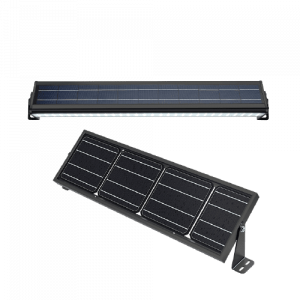
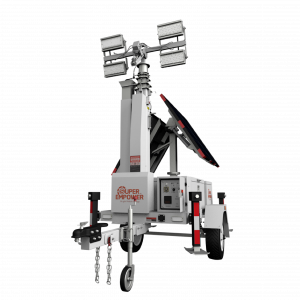
Explore our application-specific product series designed for commercial, municipal, architectural, and temporary site lighting demands.
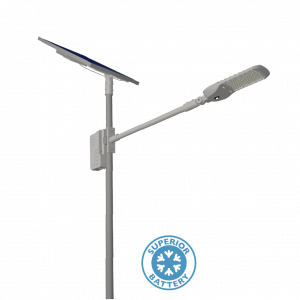
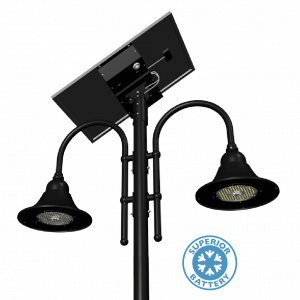
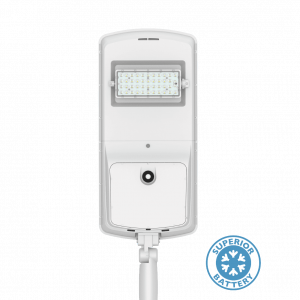
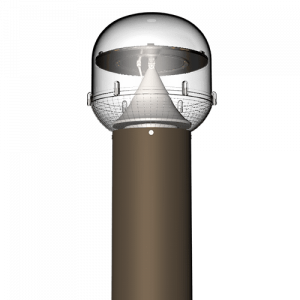
SOLTECH commercial solar lighting solutions are stocked and distributed nationwide by leading electrical supply houses and compliant with major industry bodies.









Detailed technical answers to common questions raised by electrical consultants, specifiers, and city engineers.
SOLTECH luminaires combine high-efficiency N-Type TOPCon solar panels with intelligent MPPT controllers programmed with adaptive dimming logic. During winter months with lower solar insolation, the controller adjusts the light curve based on battery SoC, maintaining core illumination across 7+ consecutive rainy or overcast days.
Municipal roadways typically require IES Type II or Type III batwing distribution to maximize lateral pole spacing without causing light gaps. Parking lots utilize Type III or Type IV for wide perimeter throw, while public parks and plazas utilize Type V symmetrical circular distribution for uniform omnidirectional coverage.
Lithium Iron Phosphate (LiFePO4) offers intrinsic thermal stability (thermal runaway threshold at +270°C), preventing explosion risks in ambient heat. It delivers over 3,500+ cycles at 80% DOD compared to 500 cycles for lead-acid, yielding a service life of 8 to 12 years with zero maintenance.
Yes. SOLTECH offers BAA-compliant commercial solar lighting configurations engineered to meet federal procurement guidelines for US DOT, municipal transportation, and government infrastructure projects receiving federal funding.
Our heavy-duty ADC12 die-cast aluminum luminaires feature low Effective Projected Area (EPA) designs certified to withstand wind velocities up to 160 mph (Category 5 hurricane speeds), fully meeting AASHTO structural standards for highway sign and luminaire supports.
Virtually zero routine maintenance is required. The hydrophobic tempered glass surfaces of the solar panels are angled to enable natural rain self-cleaning. The brushless, solid-state electronics and long-life LiFePO4 battery packs eliminate routine bulb and ballast replacements.
While solar fixtures have a slightly higher initial hardware cost, they eliminate utility trenching, copper wiring, transformer installation, electrical permits, and monthly electricity bills. The typical commercial project achieves complete ROI payback within 1.8 to 2.5 years.
Yes. SOLTECH luminaires can be equipped with standard 7-Pin NEMA or Zhaga sockets supporting IoT wireless smart nodes. This permits centralized remote monitoring, dynamic scheduling, automated fault alerts, and energy consumption reporting over cellular or LoRaWAN networks.