
2025 400W 600W 800W 1000W Solar LED Flood Light For Outdoor Commercial Canopy
- High-Mast Canopy & Sports Illumination
- Dual MPPT Smart Dimming Controller
- Grade-A LiFePO4 Battery Cell Pack

Explore our factory-engineered commercial solar canopy and flood luminaires. Designed for industrial heavy-use environments, delivering up to 200 Lm/W luminous efficacy, IP67 weather resistance, and 7-night battery autonomy.
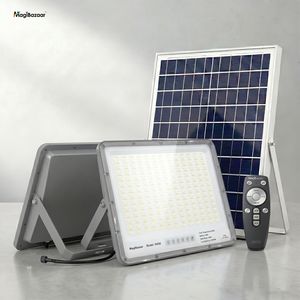
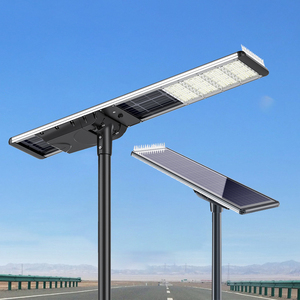
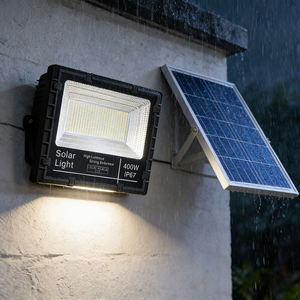
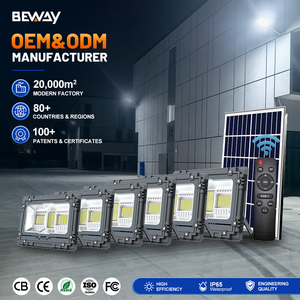
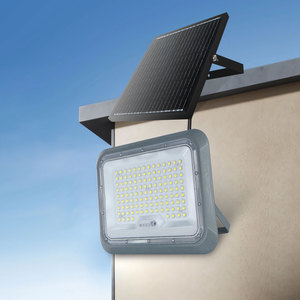
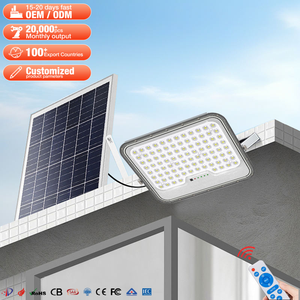
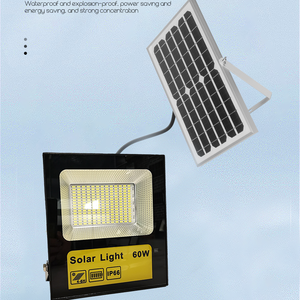
Transitioning commercial lighting infrastructure off-grid requires rigorous engineering standardizations, precise photometrics, and industrial-grade thermal management. As a premier China commercial solar canopy lighting factory operating across 5 proprietary specialized manufacturing facilities, we offer complete end-to-end OEM and ODM production capabilities.
From raw aluminum alloy die-casting to automated surface-mount technology (SMT) LED assembly, proprietary Maximum Power Point Tracking (MPPT) charge controller programming, and lithium iron phosphate (LiFePO4) battery pack packaging, our vertical integration guarantees absolute quality consistency and competitive B2B wholesale pricing.
We operate high-tonnage automated aluminum die-casting presses and cleanroom optical lens injection molding systems. This permits precision-engineered heat sinks capable of maintaining LED junction temperatures below 65°C for extended L70 lifespans surpassing 100,000 hours.
Our proprietary smart MPPT charge controllers deliver conversion tracking efficiencies exceeding 98.5%. Combined with advanced Battery Management Systems (BMS), our solar canopy luminaires dynamically balance charging algorithms, prevent thermal runaway, and ensure 7-night autonomy during extreme cloudy spells.
Our commercial solar lighting products hold international certifications including DLC Premium, UL Listed (UL 8750/1598), CE, RoHS, and offer Buy American Act (BAA) compliant engineering options. Our supply chain is trusted by global electrical distributors such as WESCO, Border States, and Platt Electric.
Commercial canopies—including petroleum service station forecourts, drive-through loading docks, industrial staging areas, and parking canopy structures—present unique optical and environmental challenges. Unlike standard post-top streetlights, canopy fixtures operate under structural ceilings where direct overhead sunlight is blocked by the roof mass itself, requiring remote or angled PV module mounting alongside customized wide-angle beam distributions.
Under commercial canopies, blinding glare presents severe safety hazards for drivers and industrial machinery operators. Standard floodlights create harsh spot glare (high Unified Glare Rating). Our commercial solar canopy fixtures incorporate micro-prismatic PC optical lenses and symmetric/asymmetric Type V and Type III light distribution curves. This distributes illumination evenly across vertical walls and horizontal pavements while cutting high-angle glare, achieving uniformity ratios (Emax/Emin) under 2.5 compliant with IESNA RP-8 guidelines.
Commercial roof overhangs and canopy structures trap extreme ambient heat during summertime operations while suffering freezing temperatures in winter. Traditional lithium nickel manganese cobalt (NMC) batteries degrade rapidly under high ambient thermal stress. We exclusively utilize high-density Grade-A Lithium Iron Phosphate (LiFePO4) chemistry engineered with built-in thermal equalization circuitry, delivering stable power delivery across temperatures ranging from -20°C to +65°C with over 3,500 80% DOD (Depth of Discharge) operational cycles.
As commercial real estate operators, municipal engineers, and logistics enterprises accelerate decarbonization initiatives, procurement criteria for off-grid canopy lighting are evolving rapidly beyond basic wattages.
Future commercial solar canopy deployments will mandate wireless IoT integration (Zigbee / LoRaWAN / Cellular NBIoT). Facility managers can remotely track battery state-of-charge (SoC), operational status, dimming profiles, and real-time energy harvesting data through centralized cloud dashboards, reducing field maintenance visits by up to 85%.
Monocrystalline solar module technology is shifting from PERC to N-Type TOPCon and Heterojunction (HJT) cells with efficiency ratings breaking 24.5%. Bifacial solar panels mounted on canopy perimeters harvest reflected albedo light from concrete ground surfaces, generating up to 25% additional daily amp-hours.
For mission-critical commercial canopies—such as 24/7 highway service hubs and high-security freight centers—procurement mandates are demanding hybrid dual-input controllers. These systems operate 95% off-grid via solar energy while automatically switching seamlessly to low-voltage AC grid power during unprecedented extended monsoon storms.
Global ESG directives require modular canopy light designs where LED optical engines, battery packs, and smart MPPT drivers can be hot-swapped individually in the field without dismantling the structural casing or mounting brackets, drastically reducing lifecycle e-waste and operational expenditure.
Next-generation microwave sensors operate with multi-frequency Doppler radar to distinguish between environmental foliage movement and incoming trucks/pedestrians. This enables dynamic power dimming (e.g., maintaining 20% ambient lux during zero traffic, ramping instantly to 100% upon vehicle approach).
Advances in flip-chip LED packaging and phosphor technology allow commercial luminaires to hit lumen outputs above 220 lumens per watt, allowing smaller solar panels and lower battery capacities to illuminate identical surface areas, bringing down initial hardware purchase costs.
While traditional AC grid lighting fixtures carry a lower initial purchase price, the required underground trenching, heavy copper wiring, electrical sub-panel installations, utility connection fees, and continuous electricity bills make grid-tied systems far more expensive over a 10-year lifecycle.
| Evaluation Parameter | Traditional Grid-Tied AC LED Canopy System | Commercial Off-Grid Solar Canopy Lighting System |
|---|---|---|
| Initial Luminaire Hardware Cost | Lower Initial Purchase Price | Moderate Initial Hardware Investment |
| Trenching, Cabling & Conduit Installation | $35 – $90 per linear foot (Extensive Trenching Needed) | $0 (Zero Underground Cable Trenching) |
| Electrical Panel & Permitting Costs | High Sub-station & Transformer Upgrade Expenses | $0 (Standalone Renewable Solar Storage) |
| Ongoing Monthly Utility Electricity Bills | Continuous Grid Expenditure (Subject to Rate Escalation) | $0 (100% Free Solar Energy Harvesting) |
| Maintenance & Cable Degradation | Higher (Wire Corrosion, Ground Fault Breaker Trips) | Minimal (Modular Driver/Battery Servicing at 8+ Years) |
| Operation During Grid Blackouts | 100% System Failure (Requires Backup Generator) | 100% Operational Resilience (Continuous Lighting) |
| Average Payback Period (ROI) | N/A (Ongoing Operating Cost) | 12 to 22 Months Total Recoupment |
Common inquiries addressed by our technical team for engineers, procurement managers, and commercial distributors.
Looking to optimize your commercial lighting RFPs, access factory-direct wholesale pricing, or request custom Dialux photometric simulations? Our engineering consultants are ready to assist your project requirements.