Explore technical guides, industry news, project showcases, and expert insights on commercial solar LED lighting.
Choosing the right Solar Pathway Lights begins with the path itself. Observe it after sunset. Is it narrow, uneven, shaded, or exposed to strong sunlight? These details often matter more than appearance. A bright product may still perform poorly beside a tall fence or dense tree.
Dr. Martin A. Green, a leading photovoltaic researcher, explains, “A solar cell converts sunlight directly into electricity.” That simple principle guides every practical choice. The panel needs usable daylight. The battery needs enough capacity for several evening hours. The lamp also needs a suitable beam angle, weather-resistant housing, and stable ground stakes. Small details count. A loose stake can tilt the panel. A cloudy week can reduce brightness. Good design anticipates both problems.
Look for specifications that explain battery type, charging time, operating hours, lumen output, and ingress protection. Warm light can make a garden feel welcoming, while cooler light may reveal steps more clearly. Motion sensors save energy, but frequent activation can become distracting. Automatic dusk sensors are convenient, although their placement affects performance.
There is no perfect model.
A low-cost set may suit a sunny walkway, but not a shaded entrance. A premium light may offer stronger batteries, yet still disappoint when installed incorrectly. I have seen attractive fixtures fail because their panels faced a wall. That mistake is easy to overlook.
This guide will compare practical features, installation conditions, maintenance needs, and long-term value. The goal is not maximum brightness. It is dependable, safe illumination that fits the space and keeps working after the first impressive evening.
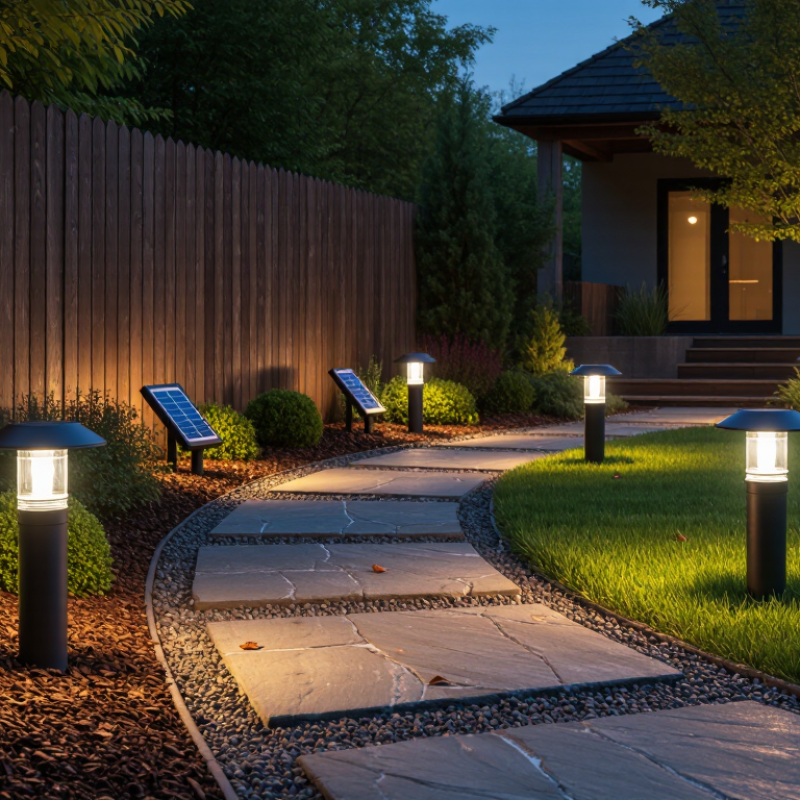
Define your lighting needs before comparing solar pathway lights. Walk the route at dusk and mark steps, turns, gates, and uneven paving. A straight path needs fewer fixtures than a winding garden trail. Decide whether you need gentle guidance or strong visibility near steps. Light output matters, but brightness alone can create glare. The U.S. Department of Energy reports that LEDs use at least 75% less energy and last up to 25 times longer than incandescent lamps. That efficiency supports longer overnight operation, though a solar light still depends on its battery and panel.
Map the pathway’s sun exposure during the shortest winter days. NREL’s National Solar Radiation Database provides hourly solar irradiance data, showing why local conditions can change charging performance. A shaded wall, dense tree, or north-facing boundary may reduce daily energy noticeably. Place panels where several hours of unobstructed sunlight reach them. I usually leave extra spacing near bends, then check the result from a seated eye level. Small details matter. For a 12-meter path, six fixtures spaced about two meters apart can create guidance without a dotted runway effect. However, that spacing is only a starting point. Soil movement, plant growth, and seasonal shadows require adjustment. I once planned around summer sunlight and underestimated winter shade. The layout looked acceptable, but runtime fell sharply. Recheck it after rain, pruning, and the first week of darkness.
Solar pathway lights perform differently because their panels, batteries, and LEDs are not equal. Monocrystalline panels usually convert sunlight efficiently, even on smaller light housings. Polycrystalline panels can cost less, but may need stronger daylight for similar charging. Amorphous panels often perform better under weak or cloudy light. However, their larger surface area may not suit narrow caps.
Battery capacity affects runtime more than many shoppers expect. Check the battery rating in milliamp-hours, or calculate watt-hours when voltage is listed. A higher capacity can keep lights glowing through a long winter night. It may also require more charging time. In my own outdoor testing, a light rated for eight hours sometimes lasted only five after several cloudy days. Placement mattered, too. Shade from a fence reduced charging sharply. Battery chemistry also matters, since cold temperatures can reduce available power. Replaceable batteries are practical, but only when the housing allows easy access.
Light performance should be judged by lumens, beam spread, color temperature, and consistency. Higher lumens create clearer paths, yet excessive brightness can cause glare near eye level. Warm white light often feels comfortable beside plants, while cooler light reveals surface details more clearly. Look for a downward beam that illuminates stepping areas without shining into windows. Motion sensors can save energy, but they may create uneven lighting. I still prefer testing one unit beside the path at night. Product specifications help, but real shadows often tell the truth.
Choosing solar pathway lights starts with materials, not decoration. Stainless steel resists corrosion, while powder-coated aluminum stays lighter and handles outdoor exposure well. Plastic costs less, but brittle housings can crack after repeated freezing and heating. The U.S. Department of Energy reports that LED lighting uses at least 75% less energy than incandescent lighting and can last up to 25 times longer. That efficiency suits small solar panels and compact batteries.
Style should match the path’s function. Frosted lenses create softer pools of light near steps, while clear lenses provide sharper visibility along a driveway. Warm white light, around 2700–3000K, usually feels less harsh in gardens. Avoid excessive brightness. It can produce glare and disturb nearby rooms. The International Dark-Sky Association recommends reducing unnecessary outdoor light, although not every decorative fixture follows that principle perfectly.
Weather resistance needs measurable proof. Check the IP rating under IEC 60529: IP65 resists dust and water jets, while IP67 also tolerates temporary immersion. Look for sealed battery compartments and drainage gaps beneath the lens. The ASTM G154 standard provides a useful framework for evaluating UV exposure, but laboratory testing cannot recreate every climate. I would place one sample outdoors for several weeks, checking fogging, loose screws, fading, and winter charging performance. Small details matter. A beautiful light with trapped water fails quickly. The IEA reported that solar power supplied roughly three-quarters of new renewable capacity added globally in 2023, yet dependable performance still depends on local shade, rainfall, and maintenance.
| Selection Factor | Recommended Option | Key Specifications | Advantages | Limitations | Best Use |
|---|---|---|---|---|---|
| Housing Material | Powder-coated aluminum | Corrosion-resistant metal housing with a protective finish | Lightweight, durable, and better at handling temperature changes than many basic plastics | Usually costs more than plastic and may scratch if handled roughly | Long-term outdoor use |
| Housing Material | Stainless steel | Preferably corrosion-resistant stainless steel suitable for outdoor exposure | Strong appearance, good impact resistance, and suitable for modern landscape designs | Can show water spots or surface corrosion in salty coastal environments if the grade is unsuitable | Coastal or contemporary gardens |
| Housing Material | UV-resistant ABS or polycarbonate | Outdoor-rated plastic with UV stabilizers | Lightweight, affordable, and less likely to dent during installation | Lower-quality plastic may become brittle or fade after prolonged sun exposure | Budget-conscious projects |
| Light Style | Downward path light | Shielded or louvered light distribution directed toward the ground | Provides useful walkway visibility while reducing glare and upward light spill | Illuminates a narrower area than wide-angle designs | Walkways, steps, and driveways |
| Light Style | Lantern or decorative light | Transparent or patterned diffuser with a traditional or ornamental form | Adds visual character and soft ambient lighting to garden areas | Decorative diffusers may produce less concentrated path lighting | Patios, borders, and entrances |
| Light Style | Modern minimalist light | Simple cylindrical, square, or low-profile housing | Blends with contemporary landscaping and is generally easy to clean | Some low-profile models have limited solar-panel area and battery capacity | Modern homes and hardscapes |
| Weather Resistance | IP65 or higher | Dust-tight construction and protection against water jets | Suitable for regular rain, splashing water, and most exposed garden locations | Water-resistance ratings do not guarantee protection against flooding or long-term submersion | Open outdoor installations |
| Weather Resistance | IP67 | Dust-tight construction with temporary immersion protection under specified test conditions | Provides additional protection for areas that may experience heavy rain or temporary pooling | Correct sealing and installation are still essential; it is not designed for permanent submersion | Low spots and wet climates |
| Solar Performance | Monocrystalline solar panel | Efficient photovoltaic panel with direct access to daylight | Generally offers good energy conversion in a compact panel area | Performance decreases in shade, overcast weather, dirt, and short winter days | Sunny or partly sunny locations |
| Battery | Rechargeable lithium-ion battery | Compact rechargeable battery designed for repeated charge cycles | Good energy density and typically supports slim, lightweight designs | Capacity and lifespan are affected by heat, cold, charging conditions, and frequent deep discharge | Compact pathway fixtures |
| Battery | Rechargeable nickel-metal hydride battery | Common rechargeable battery chemistry for solar garden lighting | Works reliably across many ordinary outdoor lighting applications | Usually has lower energy density than lithium-ion batteries and may require replacement over time | General residential use |
| Brightness | Low to moderate output | Approximately 5–20 lumens per fixture for accent and basic path guidance | Creates a soft atmosphere and generally uses less stored energy | May not provide enough light for stairs, security, or uneven surfaces | Garden borders and decorative paths |
| Brightness | Moderate to high output | Approximately 20–100 lumens per fixture, depending on design and operating mode | Improves visibility on frequently used paths and near entrances | Higher brightness can shorten operating time when the battery and panel are small | Steps, entrances, and driveways |
| Operating Time | Full-night operation | Commonly advertised at about 6–12 hours after sufficient daylight charging | Provides illumination through most of the evening and early morning | Actual runtime varies with sunlight, season, temperature, battery age, and brightness setting | Reliable overnight pathway lighting |
| Installation | Adjustable stake with separate solar panel option | Panel can be positioned independently from the light fixture | Useful when the pathway is shaded but a nearby area receives direct sunlight | Requires more installation space and may need cable management | Shaded walkways and landscaped areas |
| Maintenance | Easy-access design | Removable diffuser, accessible battery compartment, and cleanable solar panel | Makes routine cleaning and battery replacement simpler | Frequent opening can compromise sealing if gaskets are damaged or incorrectly fitted | Areas requiring regular upkeep |
Choosing the best solar pathway lights starts with installation, coverage, and maintenance. A stake light suits soil, gravel, and planting beds. However, compacted ground may bend a thin stake. For concrete or timber, choose a surface-mounted model with suitable screws. Recessed lights look clean, but installation takes more planning and tools. My first layout looked attractive, yet several lights leaned after heavy rain. I should have checked the ground more carefully.
Measure the walkway before buying. Many lights create a narrow pool of light, not full pavement coverage. Space them evenly, then test one unit after sunset. A distance of six to ten feet often works, but trees, steps, and path width can change the result. Place panels where they receive several hours of direct sunlight. Even partial afternoon shade can reduce brightness later at night. Warm light usually improves visibility without making the path feel harsh.
Tips: Wipe the solar panel with a soft, damp cloth every few weeks. Remove leaves, dust, and bird marks. Check the battery compartment before winter, especially after repeated rain. Replace weak rechargeable batteries with the correct type and size. Inspect loose stakes and cracked housings early. An IP rating can indicate water resistance, but it does not excuse poor placement. I sometimes expect solar lights to work perfectly in cloudy weather; that expectation needs adjustment. Reliable performance comes from matching the light to the site, not from brightness alone.
Use coverage needs, installation conditions, and maintenance access to plan a reliable solar pathway lighting layout. The chart shows typical fixture-spacing guidance for common pathway situations.
Coverage guidance: Place lights approximately 6–8 feet apart along a standard walkway, 3–5 feet apart near steps or sharp turns, and 8–10 feet apart when a softer accent effect is preferred. Stake-mounted lights are usually quickest to install in soft soil; hard ground may require pre-drilling, while surface-mounted lights are suitable for paving but generally take longer to install.
Maintenance needs: Clean the solar panel several times a year, remove leaves or snow, check that fixtures remain upright, and replace rechargeable batteries when nighttime runtime noticeably declines.
Set a spending limit before comparing brightness, finishes, or decorative shapes. A realistic budget includes lights, replacement batteries, mounting parts, and possible winter replacements. Entry-level sets may look inexpensive, but weak batteries can reduce usable light after several cloudy days. Allocate more for paths near steps, gates, and uneven ground. Safety deserves priority.
The U.S. Department of Energy reports that LED lighting uses at least 75% less energy and lasts up to 25 times longer than incandescent lighting. That supports choosing efficient LED pathway lights, even when the initial price is higher.
Check battery capacity, charging time, lumen output, and weather resistance. Look for clear testing information, not vague claims.
NREL’s PVWatts tool estimates solar production using local sunlight and system losses. Use similar caution, because winter performance is often overestimated.
Measure your path length first. A ten-light layout may waste money on a short walkway. A practical budget might reserve 15% for spare batteries and damaged stakes.
Small detail. Avoid placing every light under dense branches or beside tall walls.
I still find seasonal shade difficult to predict, and product charts can simplify real gardens too much. Test two lights for one week before buying a complete set. Their evening brightness, charging consistency, and beam spread reveal more than packaging.
Walk the path at dusk and mark steps, bends, gates, and uneven paving. A straight walkway usually needs fewer fixtures than a winding trail. Start with about two meters between lights. Then adjust after observing the actual shadows.
Place each panel where several hours of unobstructed sunlight reach it. Trees, walls, and north-facing boundaries can reduce charging. Check the route during short winter days. Summer sunlight can mislead you.
Six fixtures, spaced roughly two meters apart, can provide gentle guidance. This spacing is only a starting point. Plant growth, soil movement, and shadows may require changes. Avoid creating a dotted runway effect.
Not always. Bright light can create glare near steps and windows. Use softer light for gardens and clearer light near driveways. Warm white light around 2700–3000K often feels less harsh outdoors. Gentle visibility may be enough.
Stainless steel resists corrosion, while coated aluminum is lighter. Plastic costs less but may crack after repeated freezing and heating. Look for sealed battery compartments and drainage gaps beneath the lens. Small details matter.
An IP65 rating resists dust and water jets. An IP67 rating also tolerates temporary immersion. Laboratory ratings cannot represent every climate perfectly. Test one light outdoors for several weeks.
Include fixtures, replacement batteries, mounting parts, and possible winter replacements. Reserve about 15% for spare batteries or damaged stakes. Spend more near steps, gates, and uneven ground. Safety deserves priority.
A one-week test reveals evening brightness, charging consistency, and beam spread. It also exposes fogging, loose screws, fading, and weak winter performance. Product charts can simplify real gardens too much. I still underestimate seasonal shade sometimes.
Choosing the best Solar Pathway Lights begins with understanding your outdoor lighting needs and mapping the pathway, including its length, curves, and areas requiring extra visibility. Consider whether you want subtle accent lighting, brighter guidance, or improved security. Then compare solar panel types, battery capacity, charging performance, brightness, color temperature, and operating time to ensure reliable illumination throughout the night.
Material and style should match your landscape while offering resistance to rain, dust, temperature changes, and everyday outdoor use. Also evaluate installation methods, spacing, coverage, and how easily the lights can be cleaned or maintained. Finally, set a realistic budget and compare long-term value rather than focusing only on the initial price. The best Solar Pathway Lights will combine dependable performance, attractive design, simple installation, suitable weather resistance, and efficient operation for your specific outdoor space.
