Explore technical guides, industry news, project showcases, and expert insights on commercial solar LED lighting.
Along a dark beach, a bright white lamp can change the view that a newly hatched sea turtle follows toward the ocean. Artificial light near nesting areas may disorient hatchlings, so coastal buyers need more than a solar panel and attractive housing. Turtle Friendly Solar Lights are designed to reduce unnecessary glare, often through warmer amber or red light, careful shielding, and lower brightness. Small details matter.
This guide compares ten options for global buyers, with attention to light color, controls, construction, and practical installation. A hooded fixture aimed down at a path can behave differently from an exposed lamp facing the shore. Look for clear product specifications, replaceable parts, weather resistance, and realistic battery information. Check the manufacturer’s wavelength and brightness data rather than relying on vague “eco-friendly” claims. Not always easy.
Solar performance also depends on sunlight, season, shade, and local weather. A lamp that works well in a sunny garden may provide fewer hours after cloudy days. Buyers should review regional guidance for coastal lighting and consult local conservation professionals where nesting activity is present. No product is harmless in every setting. Even a turtle-conscious design can cause problems if it is too bright or poorly positioned. The selections ahead offer a starting point, not a substitute for site-specific care.
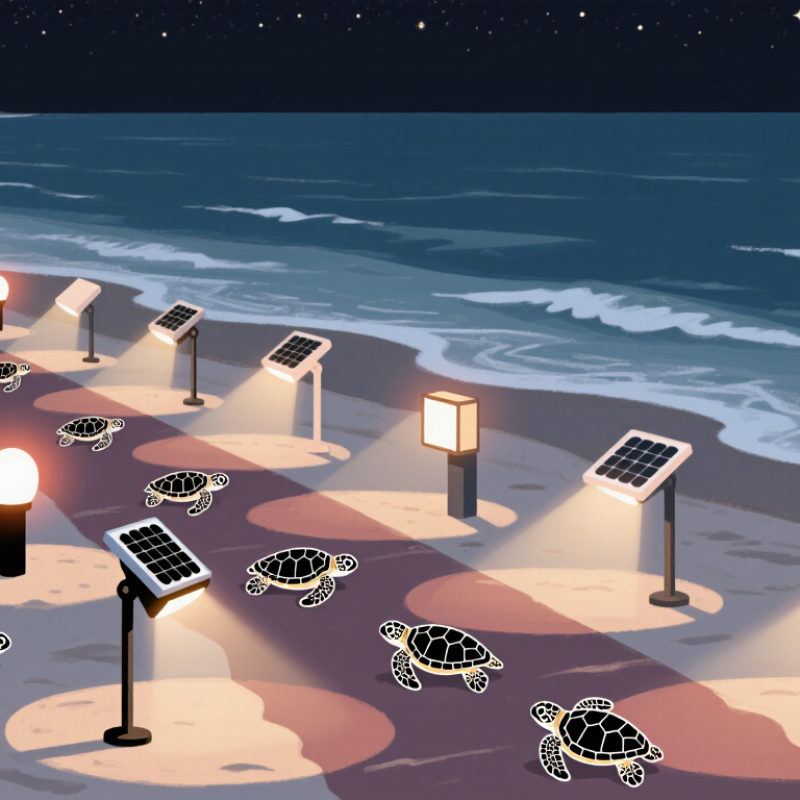
A turtle-friendly solar light controls where its light goes, how bright it is, and which wavelengths it emits. Sea turtle hatchlings rely on natural horizon cues; bright artificial light can draw them inland instead of toward the sea. The U.S. Fish and Wildlife Service and NOAA Fisheries’ sea-turtle lighting guidance favors long-wavelength light, around 560 nanometers or above, because shorter blue-green wavelengths are more likely to attract turtles. Amber color alone is not enough.
Look for a fixture with a warm amber or red output, a fully shielded lens, and a low mounting height. Aim it down, away from beaches, dunes, and windows. A motion sensor or timer can reduce unnecessary nighttime glow. Solar-powered models still need careful placement: a bright panel-side indicator or exposed lens may create stray light. Check the actual light output, not just the product’s “turtle-friendly” label. Small details matter.
Tips: Test the light after dark from the beach-facing side. If the lens is visible or the sand is brightly lit, add shielding, lower the fixture, or choose a dimmer setting. Keep in mind that local conditions vary; even a well-designed light can be poorly placed.
Artificial lighting can interrupt a sea turtle’s journey before it reaches the water. Hatchlings usually crawl toward the brighter, open horizon over the ocean. Streetlamps, porch lights, and exposed garden fixtures can create a competing glow inland. A hatchling may turn toward a road instead. That can mean dehydration, exhaustion, or collision. Small changes matter. NOAA Fisheries estimates that only about one in 1,000 to one in 10,000 hatchlings survives to adulthood, making each hatchling’s first journey especially precarious.
Solar power does not make a light turtle-safe. The light’s direction, brightness, color, and operating time still matter. Choose fully shielded fixtures that aim light down, use the lowest practical output, and switch off when illumination is unnecessary. Amber or red light is often preferred near nesting beaches, but it is not impact-free; distance and intensity count too. Florida Fish and Wildlife Conservation Commission guidance emphasizes reducing beachfront lighting that is visible from the shore. Picture a bright pool of light spilling across pale sand: even a small fixture can be conspicuous at night. Motion sensors may help, though they can still flash on at the wrong moment. I would check the beach-facing view after dark, not just the product label.
These are lighting categories and practical selection targets, not a ranking of specific products. Sea turtle hatchlings can be disoriented by artificial light, particularly bright, unshielded, short-wavelength light. Where possible, keep beachfront areas dark at night.
| Option | Suitable use | Preferred light color | Practical output target | Recommended placement and controls | Turtle-conscious note |
|---|---|---|---|---|---|
| 1. Shielded amber path marker | Short paths away from the beach | Amber, approximately 590–620 nm | About 10–30 lumens per fixture as a starting point | Keep low, point light downward, and use opaque shielding on the beach-facing side. | Use only where needed; long-wavelength amber is generally less disruptive than blue-rich white light, but is not risk-free. |
| 2. Red or deep-amber step light | Steps, entrances, and low-level safety marking | Red or deep amber, approximately 620 nm or longer | About 5–20 lumens per fixture as a starting point | Mount close to the step surface and aim away from the shoreline. | Keep the illuminated area small; avoid exposed LEDs that can be seen directly from the beach. |
| 3. Fully shielded wall light | Doors and building access points | Amber, approximately 590–620 nm | Use the lowest output that safely illuminates the access area; often 50–150 lumens is a reasonable starting range. | Use a full cutoff fixture mounted under an eave, with no light escaping horizontally or toward the beach. | Do not use an exposed bulb or an upward-facing wall fixture near nesting habitat. |
| 4. Motion-activated security light | Occasional security lighting away from nesting areas | Amber or red if available; avoid blue-rich white light | About 100–300 lumens, only when activated | Choose a short timer, a downward beam, and a motion sensor aimed away from the beach. | Frequent activation can create repeated disturbance. Do not direct the beam across the shoreline or nesting beach. |
| 5. Low-output solar bollard | Path edges in landscaped areas set back from the shore | Amber, approximately 590–620 nm | About 10–30 lumens per bollard as a starting point | Choose a downward-facing, shielded design and space fixtures only where guidance is necessary. | Decorative glowing tops and clear lenses can spread light sideways; select an opaque, louvered design instead. |
| 6. Recessed solar step or deck light | Deck edges and stair treads | Red or amber, approximately 590 nm or longer | About 5–20 lumens per fixture as a starting point | Recess or shield the light so it illuminates the walking surface rather than the horizon. | Prefer a small pool of light over continuous bright illumination along the entire deck. |
| 7. Shielded solar rail light | Handrails and balcony edges | Amber, approximately 590–620 nm | About 5–20 lumens per fixture as a starting point | Mount below the rail top and direct the beam inward and downward. | Avoid fixtures that glow above the railing or create a visible line of light from the beach. |
| 8. Solar address or wayfinding marker | Property numbers and essential wayfinding | Red or amber, approximately 590 nm or longer | About 1–10 lumens, or the lowest legible setting | Use a small, shielded panel and keep it facing the property approach. | Keep illuminated signs small and avoid bright, internally glowing panels near the coast. |
| 9. Shielded driveway marker | Driveways and parking areas set back from nesting habitat | Amber, approximately 590–620 nm | About 10–30 lumens per marker as a starting point | Use low-mounted fixtures with full shielding; avoid lighting the beach, dunes, or water. | For larger areas, use a few carefully aimed fixtures rather than many unshielded lights. |
| 10. Portable solar task light with manual switch | Temporary repairs or occasional outdoor tasks | Amber or red where practical | About 50–150 lumens while in use | Direct the beam at the task, switch it off immediately afterward, and store it indoors when not needed. | A portable light is not automatically turtle-safe; avoid shining it toward the beach, turtles, or the sea. |
Important: The lumen ranges above are practical starting points for product selection, not universal biological safety limits or legal standards. Turtle responses vary by species and location, and amber or red light can still cause disturbance. Follow local coastal lighting rules and wildlife-authority guidance; some jurisdictions require approved fixtures or specific lighting plans.
A turtle-friendly label is only a starting point. Compare emitted color, brightness, beam direction, and controls. Prefer amber or red light with a documented spectrum; color names alone can be vague. Low output and fully shielded fixtures help limit light spilling toward beaches and water. Check whether the lamp points downward and whether nearby walls or paving still glow. Small details matter.
For global buyers, compare solar-panel size, battery capacity, and expected runtime after cloudy days. A lamp that works well in a sunny showroom may dim after several overcast evenings. Look for replaceable batteries, weather-resistant construction, and clear performance data. Motion sensors and timers can reduce unnecessary illumination, but test their settings before relying on them. This comparison is imperfect: placement and surrounding light can change the result considerably.
Tips: Set the fixture low and aim it away from the shore. After dark, stand near the water and check for visible glare. If the area still looks bright, adjust or switch off the light. When nesting habitat is nearby, seek site-specific wildlife guidance before installation.
Choosing among ten turtle-friendly solar lights starts with the light itself, not its advertised brightness. Near beaches and nesting areas, warm amber or red LEDs are generally preferable to blue-white light, which can disorient hatchlings. Look for fixtures that direct light downward and use full shields to prevent glow from reaching the shore. Small details matter. A lamp mounted low beside a path may be less disruptive than a bright pole light, even when both illuminate the same area.
For global buyers, compare practical features as carefully as color. Check the stated weather resistance, battery capacity, replacement options, and charging performance in cloudy conditions. A motion sensor or timer can reduce unnecessary nighttime illumination, but it should not leave steps or access routes unsafe. Solar output also varies by season and latitude. A panel that charges well in summer may struggle during long, overcast winter days.
No fixture is perfect. Installation, nearby windows, and reflective surfaces can change where light travels. Review the full product specifications, then test the lamp after dark from the shoreline or habitat edge, where appropriate. If the beam is visible across the sand, adjust its angle or choose a lower-output option. Local wildlife guidance can help buyers make a more reliable choice. I would not assume that a “turtle-friendly” label alone proves a light is suitable.
Near turtle habitat, placement matters as much as brightness. Florida Fish and Wildlife Conservation Commission guidance recommends long-wavelength lighting, generally 560 nanometers or longer. Choose amber, orange, or red LEDs, and check the measured wavelength rather than trusting a “turtle-friendly” label. The label alone proves little. NOAA Fisheries guidance also favors shielded fixtures that prevent light from spilling onto beaches. Keep lights low, point them downward, and use the lowest useful output. A bright path is not always a safer path.
Before installation, walk the site after dark. Look from the beach toward the building; visible bulbs and bright windows can still disturb hatchlings. Mount solar fixtures behind dunes or landscaping where practical, but do not block natural turtle access or damage vegetation. Aim beams at paths, not sand or water. Motion sensors and timers can reduce unnecessary nighttime lighting, though sensor settings may need adjustment after observing actual use. A small test helps. FWC’s 560-nanometer benchmark is useful, but real-world spill depends on distance, shielding, and surface reflection. Recheck the setup after rain, when wet paving can reflect light farther than expected. I would not assume one fixture works equally well on every coastline.
Choose a warm amber or red light, a fully shielded lens, and a low mounting height. Aim it down.
No. Wavelength, brightness, direction, and distance all matter. Guidance often favors wavelengths around 560 nanometers or above.
Hatchlings follow the brighter, open horizon toward the ocean. A porch light spilling across pale sand can pull them inland.
Not by itself. An exposed lens or bright indicator can still create stray light after dark.
Use the lowest practical setting and switch the light off when it is not needed. A timer or motion sensor may help.
Check it after dark from the beach-facing side. If you can see the lens or a bright patch on the sand, adjust it or choose a dimmer setting.
Check weather resistance, battery capacity, replacement options, and cloudy-weather charging. Solar output can change with season and latitude.
Yes. Nearby windows, reflective surfaces, and poor placement can send light toward habitat. I might overlook a small reflection, so check the site again.
Turtle Friendly Solar Lights are designed to provide useful outdoor illumination while reducing light that could disturb sea turtles. Artificial lighting near coastal habitats may confuse hatchlings as they move toward the ocean and disrupt the natural behavior of adult turtles. Choosing suitable lighting therefore involves more than brightness: consider light color and direction, shielding, brightness settings, solar-panel performance, battery capacity, weather resistance, durability, and ease of installation.
This guide compares ten types of turtle-conscious solar lights for buyers in different regions, highlighting the features that can help balance visibility with reduced nighttime impact. It also explains how to assess your site before choosing a light, position fixtures away from beaches and nesting areas where practical, aim beams downward, and use only the illumination needed. Thoughtful selection and installation can make outdoor spaces safer and more functional while helping limit unnecessary light near turtle habitats.